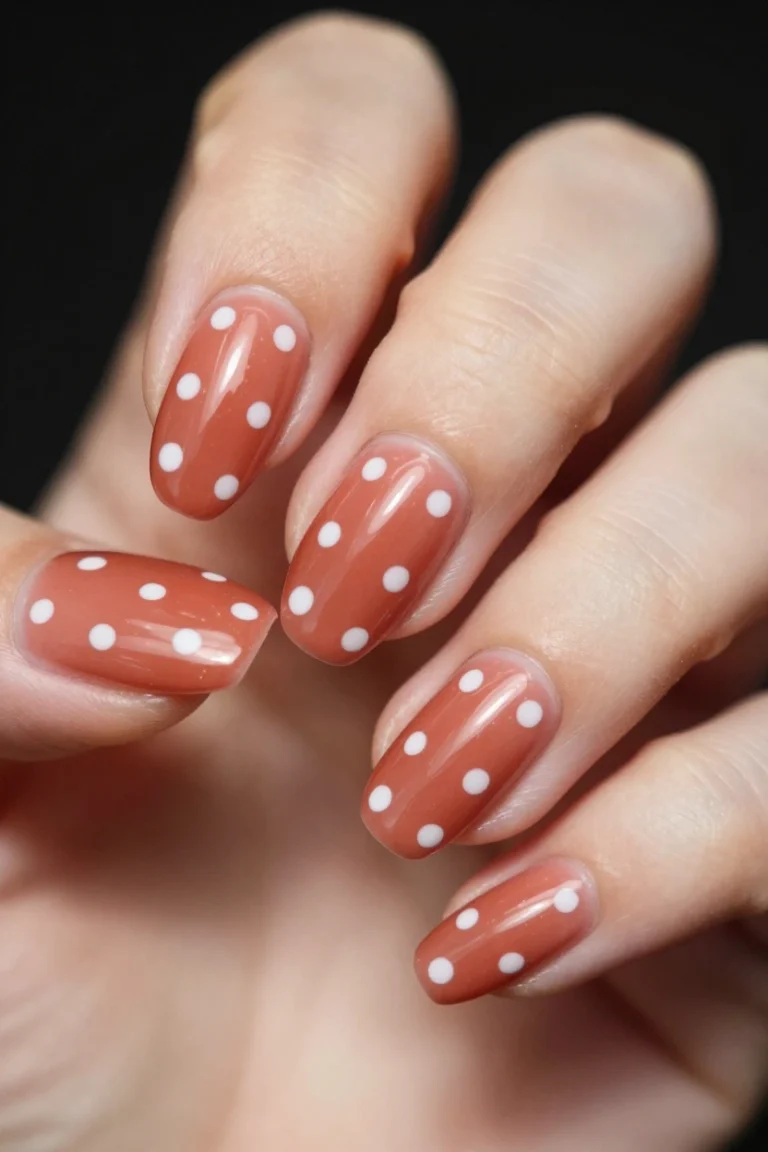
17 Stunning Tulip Nails Ideas to Embrace Fresh Spring Elegance
Tulip nails are one of the most searched spring nail trends right now — and most guides just show pretty pictures without telling you how to actually do them at home or what to expect after two weeks of wear. This guide is different. Every one of these 17 Tulip nails designs includes complete step-by-step instructions, specific product names with prices, difficulty ratings, and honest notes about what goes wrong and how to fix it.
Whether you’re brand new to nail art or looking for your next salon request, you’ll find designs that actually work for your skill level and lifestyle — not just ones that look good in photos.
How to Choose the Right Tulip Design for You
There are 17 designs below, which can feel overwhelming. Here’s how to narrow it down quickly based on your situation:
- For your first time doing nail art: Start with Design #1 (Soft Pink Tulip Tips) or #6 (Rainbow Pastel Tulip Mix). Both use straightforward techniques and are forgiving of small mistakes.
- If you have a professional job: Designs #2, #5, #12, or #13 all work in conservative environments. Stick to one or two accent nails and neutral base colors.
- For a special event (wedding, party, graduation): Design #4 (Lavender with Gold Foil), #16 (Dewdrop Tulips), or #11 (3D Accents) photograph beautifully and feel elevated.
- If you’re comfortable with nail art and want a challenge: Try #7 (Ombré Pink Fade), #10 (Chrome Silhouettes), or #14 (Full-Coverage Mural). These take real skill and patience.
- If you have short nails: Designs #5 (Sage Green), #8 (Black Line Art), and #6 (Rainbow Pastel) scale down well. Single blooms and line art always work better than crowded florals on small nails.
- If you change your nail color often: Avoid #10 (Chrome) and #11 (3D Sculpted) — they require gel systems and more removal effort. Stick to regular polish designs you can change in 10 minutes.
Minimalist & Romantic Tulips
1. Soft Pink Tulip Tips
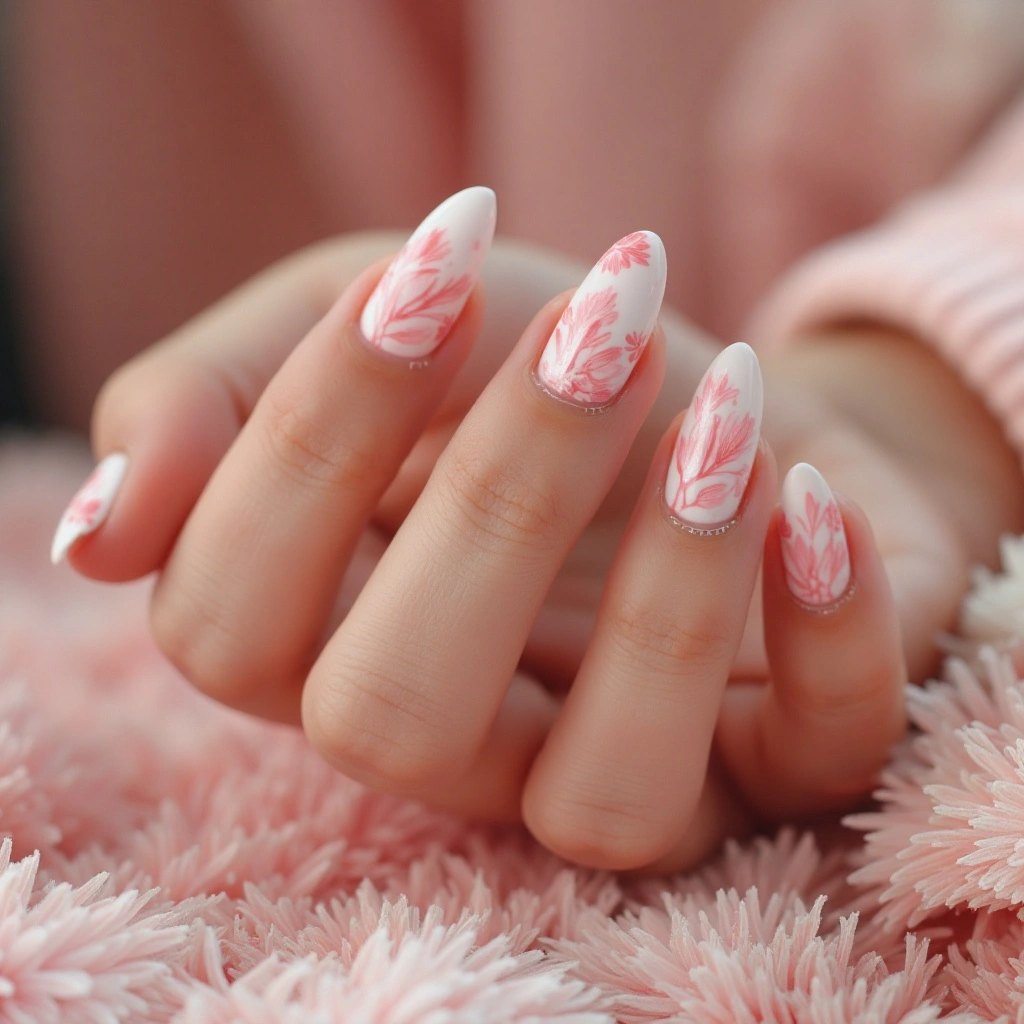
Delicate baby pink tulips painted along the tips of almond-shaped nails create an effortlessly feminine look. The petals are rendered in watercolor-style strokes with subtle white highlights, giving them a dreamy, ethereal quality. A glossy topcoat enhances the fresh-picked flower effect while keeping the design soft and sophisticated.
| Detail | Info |
| Difficulty | Beginner |
| Time to complete | 30–40 minutes |
| Best for | First-time nail art; everyday wear |
Why it works: Tip placement keeps the design practical — your nails don’t look ‘busy’ but there’s still clear nail art visible. The watercolor effect hides small mistakes because there are no hard edges.
What makes it different: Most tulip tip designs use solid color. The wet-on-wet blending here gives a softer, more organic look that reads as intentional rather than painted-on.
What to expect: The wet-on-wet blending is time-sensitive. If you wait too long between steps the colors won’t blend, they’ll just sit on top of each other. Work one hand at a time.
2. White Tulip French Twist
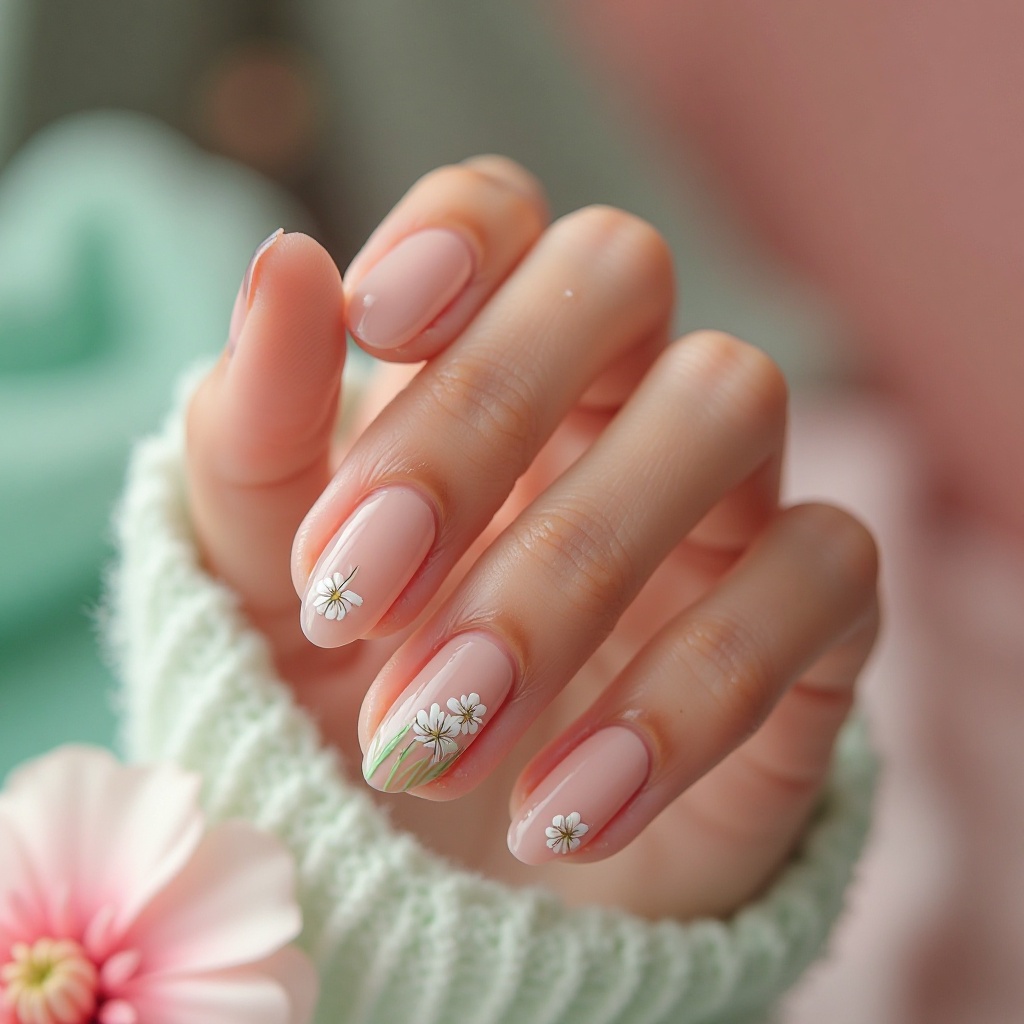
Classic French tips get a springtime upgrade with tiny white tulips painted on a sheer nude base. Each nail features one to two tulips with soft green stems, positioned diagonally across the nail bed. The minimalist approach keeps it sophisticated while the floral detail adds unexpected charm.
| Detail | Info |
| Difficulty | Beginner–Intermediate |
| Time to complete | 25–30 minutes |
| Best for | Professional settings; people who like classic manicures with a twist |
Why it works: The French manicure base is familiar and polished, so the tulip detail reads as ‘elevated’ rather than ‘busy.’ It’s nail art that gets compliments from people who don’t usually notice nail art.
What makes it different: Traditional French tips use a curved white line across the tip. Here, the tulip replaces that line while maintaining the same clean, work-appropriate vibe.
Tip: Limit the floral detail to two nails (ring finger and thumb). Other nails stay plain nude. This is what keeps it office-appropriate.
Bold & Colorful Blooms
3. Sunset Tulip Garden
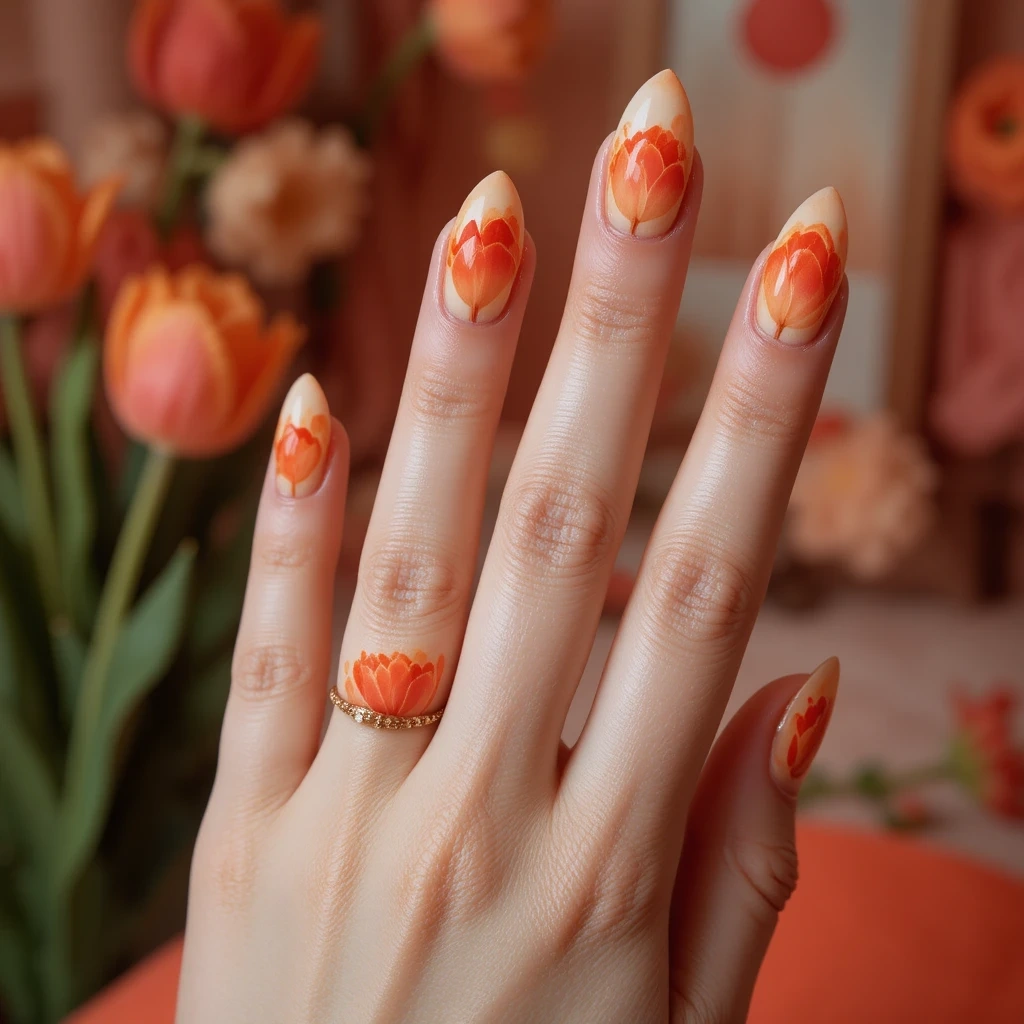
Vibrant orange and coral tulips burst across a warm cream base, creating a bold statement that screams spring confidence. The flowers feature gradient petals that shift from deep tangerine to soft peach, with dimensional shading that makes them pop. Scattered across different nails in varying sizes, this design feels like walking through a tulip field at golden hour.
| Detail | Info |
| Difficulty | Intermediate |
| Time to complete | 45–60 minutes |
| Best for | People who want bold, eye-catching nails for casual occasions |
Why it works: The gradient petals create a ‘depth’ effect that makes the flowers look almost three-dimensional without any 3D technique. The warm palette reads as energetic rather than overwhelming.
What makes it different: Most orange nail art ends up looking similar. The sponge-gradient petal technique here creates flowers that genuinely look different from nail to nail, which prevents the design from feeling repetitive.
Honest note: The sponge technique is messy the first time. Practice on your non-dominant hand first and expect to clean up the edges.
Elegant Accent & Chrome Details
4. Lavender Tulip with Gold Foil
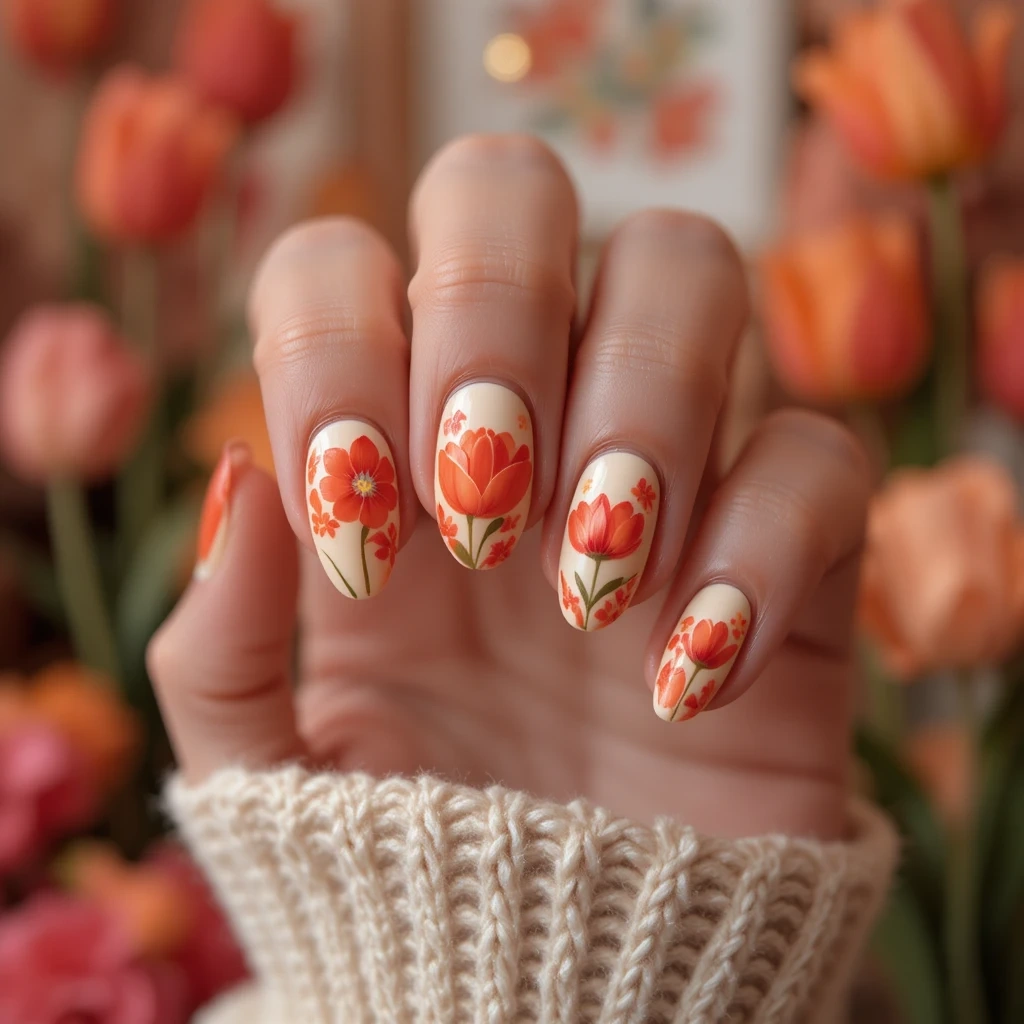
Soft lavender tulips float on a milky white base, accented with delicate gold foil stems and leaves that catch the light. The purple petals have a semi-translucent quality that feels fresh and airy, while the metallic details add just enough glamour. One or two accent nails feature this design, while others remain a clean milky white.
| Detail | Info |
| Difficulty | Intermediate |
| Time to complete | 35–40 minutes |
| Best for | Special occasions; people who want spring nails that photograph well |
Why it works: The lavender-and-gold combination reads as expensive without being overdone. The foil stems catch the light in a way that regular polish can’t replicate.
What makes it different: Most foil nail designs use foil as the entire nail. Using it only for stems and leaves means the foil becomes a detail, not the whole concept.
Key detail: Apply gold foil while there’s still a slightly tacky layer underneath. If everything is too dry the foil won’t adhere. If it’s too wet it’ll bunch up.
5. Sage Green Tulip Medley
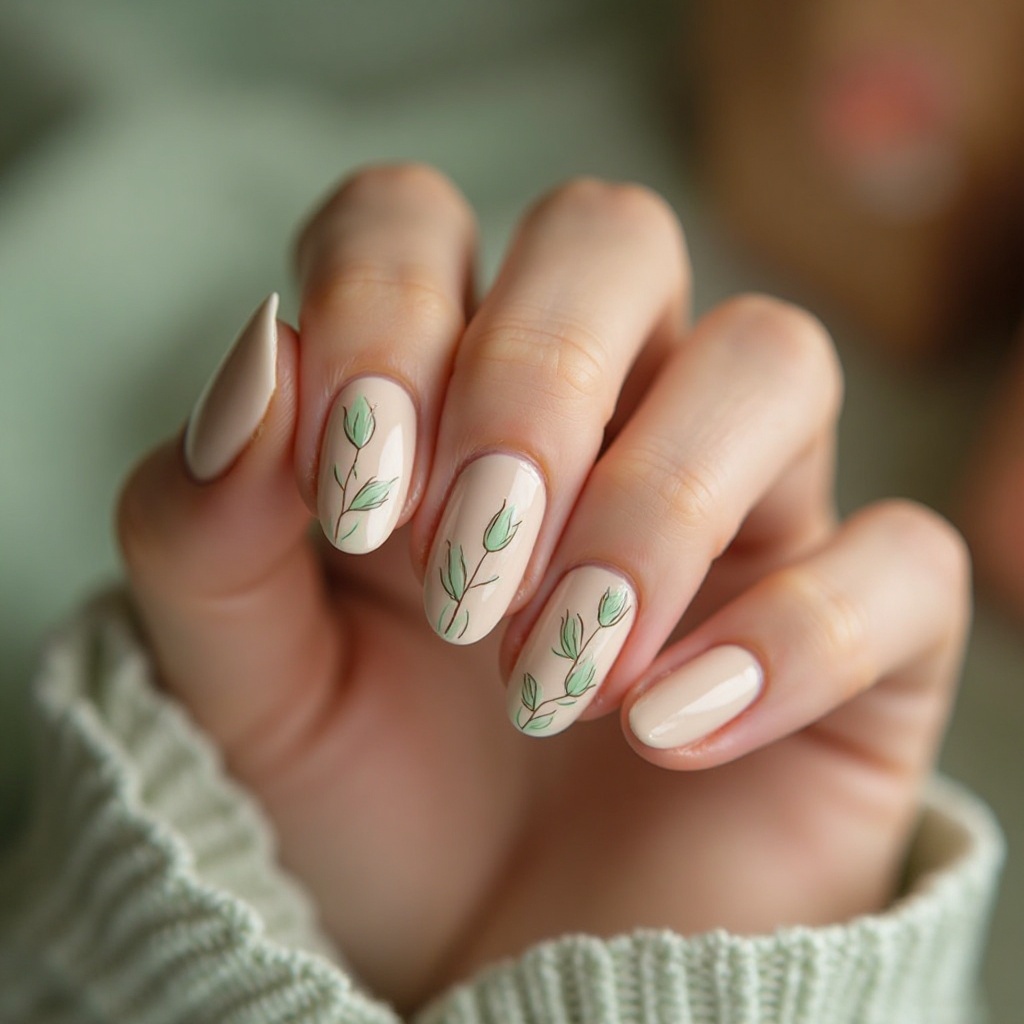
Muted sage green tulips in various stages of bloom create a botanical illustration effect across short to medium nails. Some flowers are shown in profile, others face forward, and a few are captured as closed buds, all painted with fine detail. The base is a sheer milky nude that lets the green take center stage, with tiny brown stems connecting the compositions.
| Detail | Info |
| Difficulty | Intermediate |
| Time to complete | 35–40 minutes |
| Best for | Special occasions; people who want spring nails that photograph well |
Why it works: The lavender-and-gold combination reads as expensive without being overdone. The foil stems catch the light in a way that regular polish can’t replicate.
What makes it different: Most foil nail designs use foil as the entire nail. Using it only for stems and leaves means the foil becomes a detail, not the whole concept.
Key detail: Apply gold foil while there’s still a slightly tacky layer underneath. If everything is too dry the foil won’t adhere. If it’s too wet it’ll bunch up.
Dreamy Pastel Collections
6. Rainbow Pastel Tulip Mix
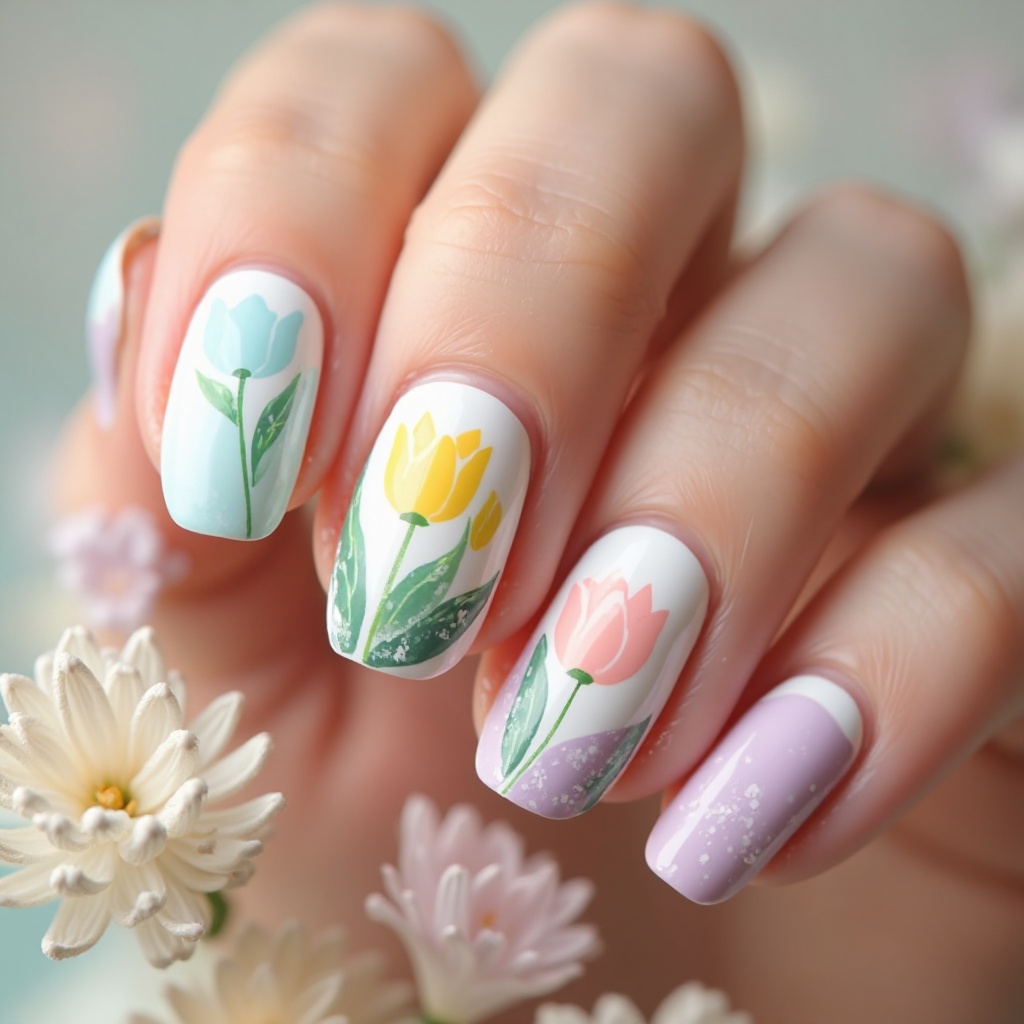
Each nail showcases a different pastel tulip—baby blue, mint green, soft yellow, pale pink, and lilac—on a crisp white base. The tulips are painted in a simple, graphic style with clean lines and solid color fills. This playful approach feels cheerful without being childish, like an Easter egg hunt in bloom form.
| Detail | Info |
| Difficulty | Beginner |
| Time to complete | 30–35 minutes |
| Best for | First-time nail art; spring events; anyone who gets bored with a single color |
Why it works: Each nail is a different color, but the consistent graphic style and shared pastel palette makes the set feel cohesive rather than random.
What makes it different: The uniformity of placement (same size tulip, same direction, same position on every nail) is what makes this read as intentional rather than chaotic. Most multi-color sets fail because the placement varies too much.
Product tip: Sinful Colors pastel collection ($2 each, drugstores) has all five shades and is well-pigmented for the price.
7. Ombré Pink Tulip Fade
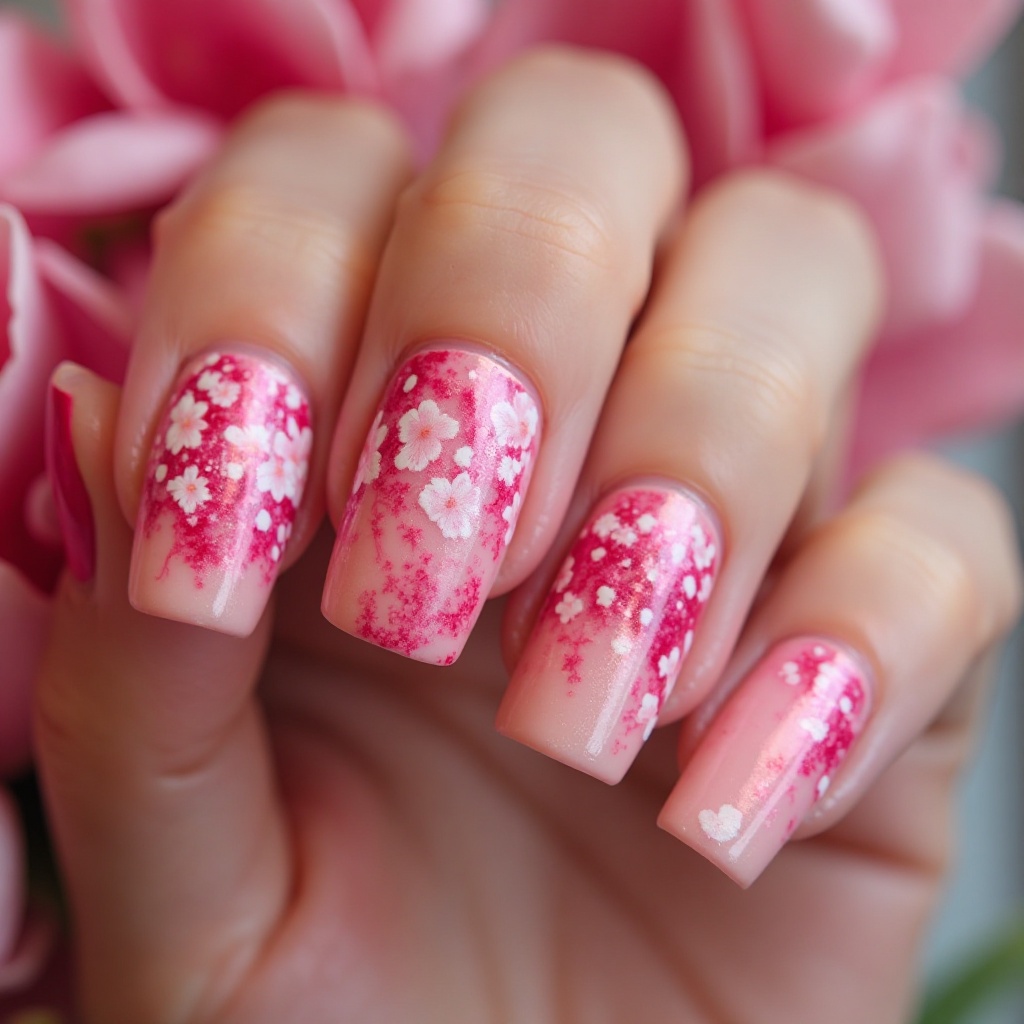
A gradient base that transitions from deep rose at the cuticle to pale blush at the tips gets adorned with tonal pink tulips throughout. The flowers blend seamlessly into the ombré background, creating a monochromatic masterpiece. Some petals are outlined in slightly darker pink for definition without harsh contrast.
| Detail | Info |
| Difficulty | Intermediate |
| Time to complete | 50–60 minutes |
| Best for | People comfortable with the sponge technique who want a high-fashion look |
Why it works: The tonal approach (same color family throughout) creates depth without requiring complex color mixing. The tulips become part of the gradient rather than sitting on top of it.
What makes it different: Most ombré nails are just gradient bases with no art. Adding tonal tulips in the mid-pink range elevates it from a basic trend to something more considered.
Honest note: Expect some mess on your skin during the sponging. This is normal. Keep a cleanup brush and acetone nearby.
Artistic & Detailed Designs
8. Black Line Art Tulips
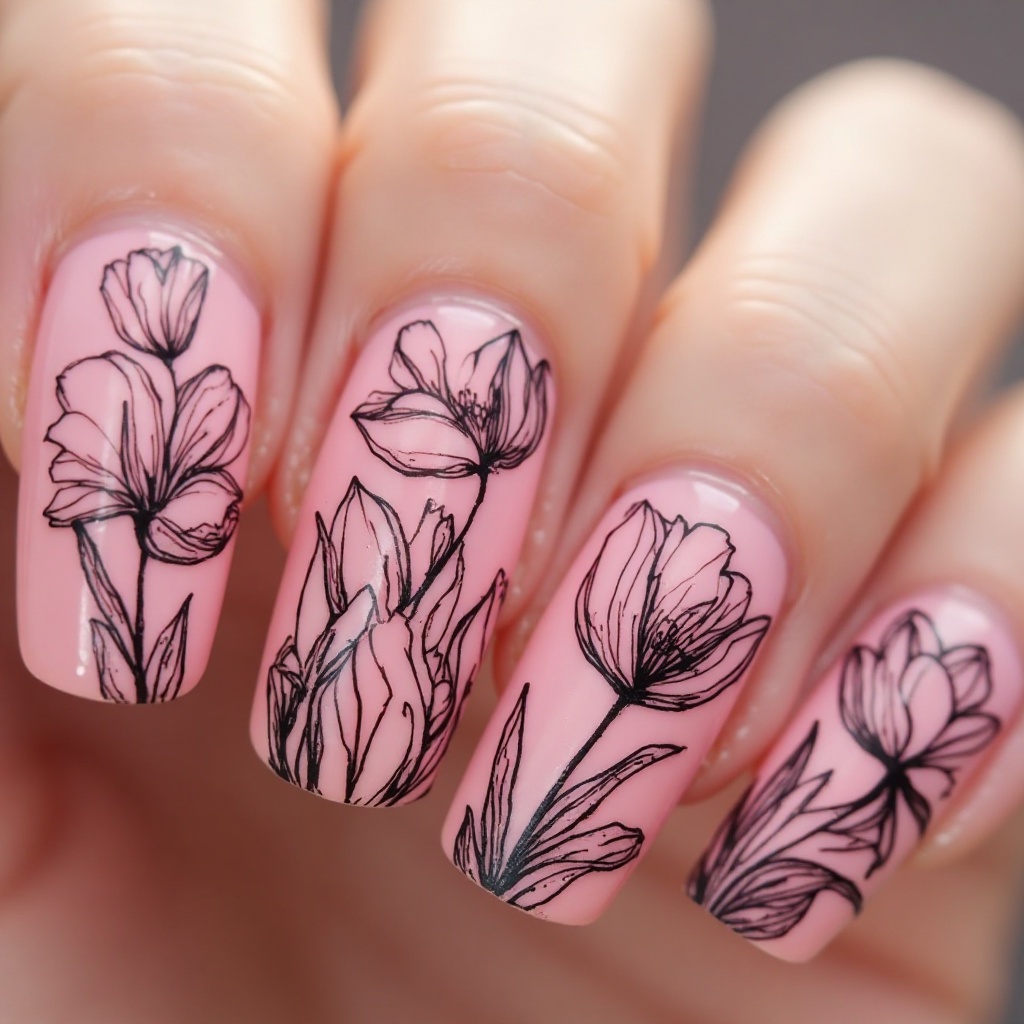
Delicate black line drawings of tulips dance across a sheer pink jelly base, creating an artistic sketch effect. The flowers are rendered with single, confident brush strokes that capture their essence without filling in color. Small details like visible stamens and leaf veins add botanical accuracy.
| Detail | Info |
| Difficulty | Beginner (line art only) |
| Time to complete | 25–30 minutes |
| Best for | Minimalists; people who want nail art without committing to heavy color |
Why it works: Working with only line work means no color-filling, no blending, and no gradient technique. The sheer jelly base is forgiving because the translucency means small errors aren’t as visible.
What makes it different: The combination of sheer base and black line art creates a modern ‘glass nails meets botanical art’ look that’s distinct from both traditional floral nails and the clean-girl minimalist trend.
Product tip: Sally Hansen I Heart Nail Art pens in black ($5, drugstores) are very beginner-friendly because the tip gives you consistent line width without loading a brush.
9. Pressed Flower Tulip Illusion
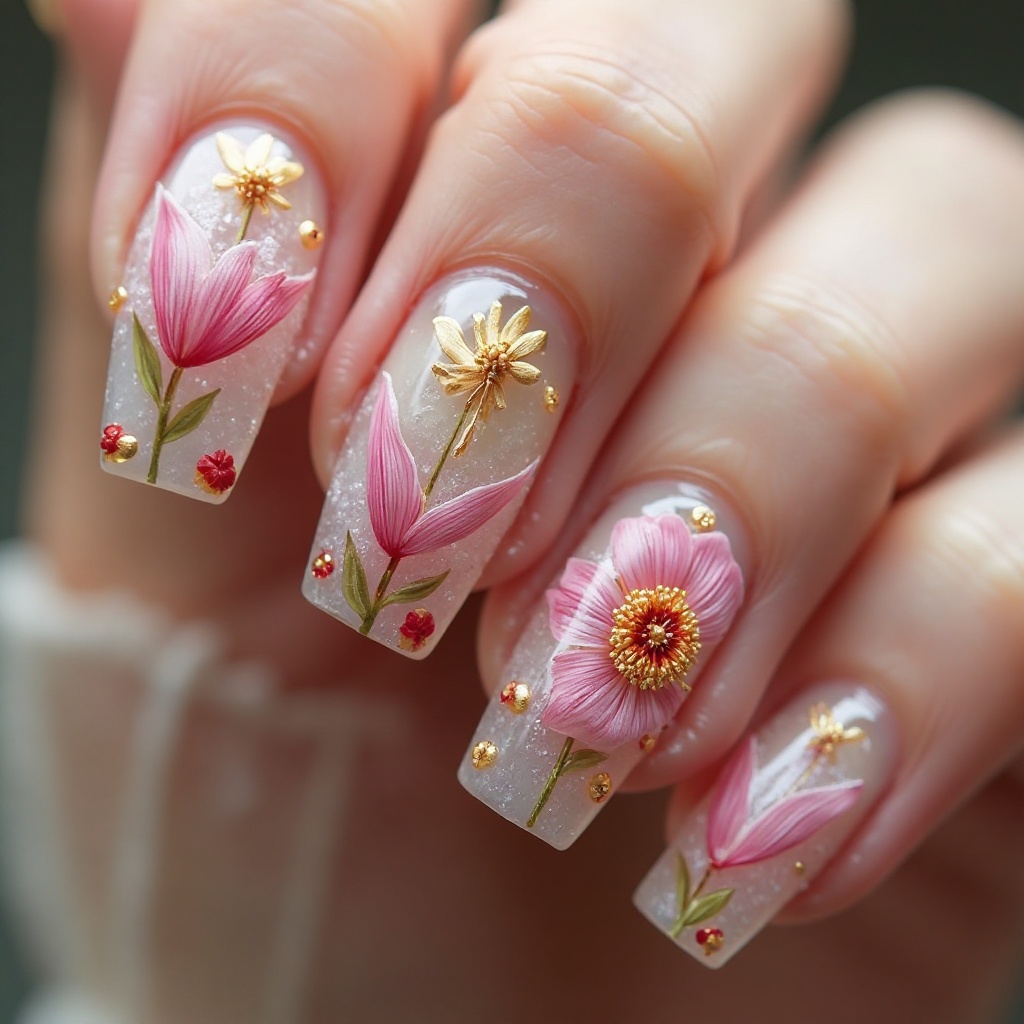
Tiny dried tulip petals appear to be pressed between layers of clear polish, though they’re actually meticulously hand-painted to create this trompe l’oeil effect. The base is crystal clear, and the “pressed flowers” have the flat, faded quality of real dried botanicals with visible petal texture.
| Detail | Info |
| Difficulty | Advanced |
| Time to complete | 60–70 minutes |
| Best for | Experienced DIYers who enjoy process-heavy nail art |
Why it works: The multiple thin topcoat layers create genuine visible depth, making it look like the petals really are encased under glass. It’s a visual trick that gets a lot of attention.
What makes it different: This is a trompe l’oeil (optical illusion) technique — the flowers are hand-painted to look like actual dried botanicals pressed flat. No real pressed flowers are used.
Honest note: The drying time between layers is where most people rush and ruin this design. If you combine two layers too soon they go cloudy. Budget the full 70 minutes.
Luxe & Glamorous Statements
10. Chrome Tulip Silhouettes
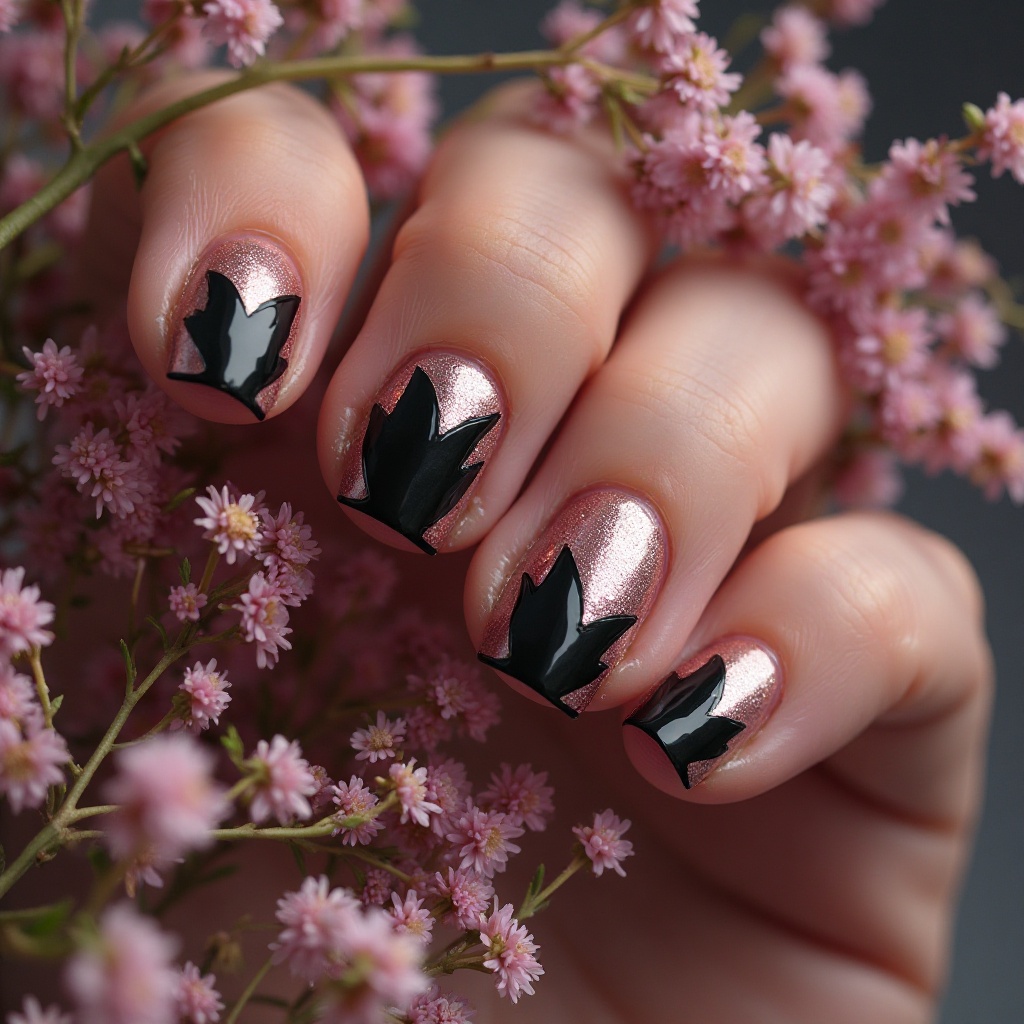
Mirror-finish chrome nails serve as the base for matte black tulip silhouettes that create dramatic negative space. The contrast between the reflective chrome and flat black is striking, while the tulip shapes soften what could otherwise feel too edgy. Available in rose gold, silver, or holographic chrome finishes.
| Detail | Info |
| Difficulty | Advanced |
| Time to complete | 45–55 minutes |
| Best for | Fashion-forward individuals comfortable with gel systems |
Why it works: The contrast between reflective chrome and flat matte black is stark enough that even a simple tulip silhouette reads as dramatic and deliberate. The tulip shape is what softens it.
What makes it different: Most chrome nail art is just chrome. The matte black silhouettes here add a second layer of interest — and the tulip shape keeps it feeling like spring rather than edgy-for-edgy’s-sake.
Supply investment: A basic gel starter kit runs $40–80 (lamp + polishes + chrome powder). You’ll reuse these for many manicures, so the per-use cost drops significantly.
11. 3D Sculpted Tulip Accents
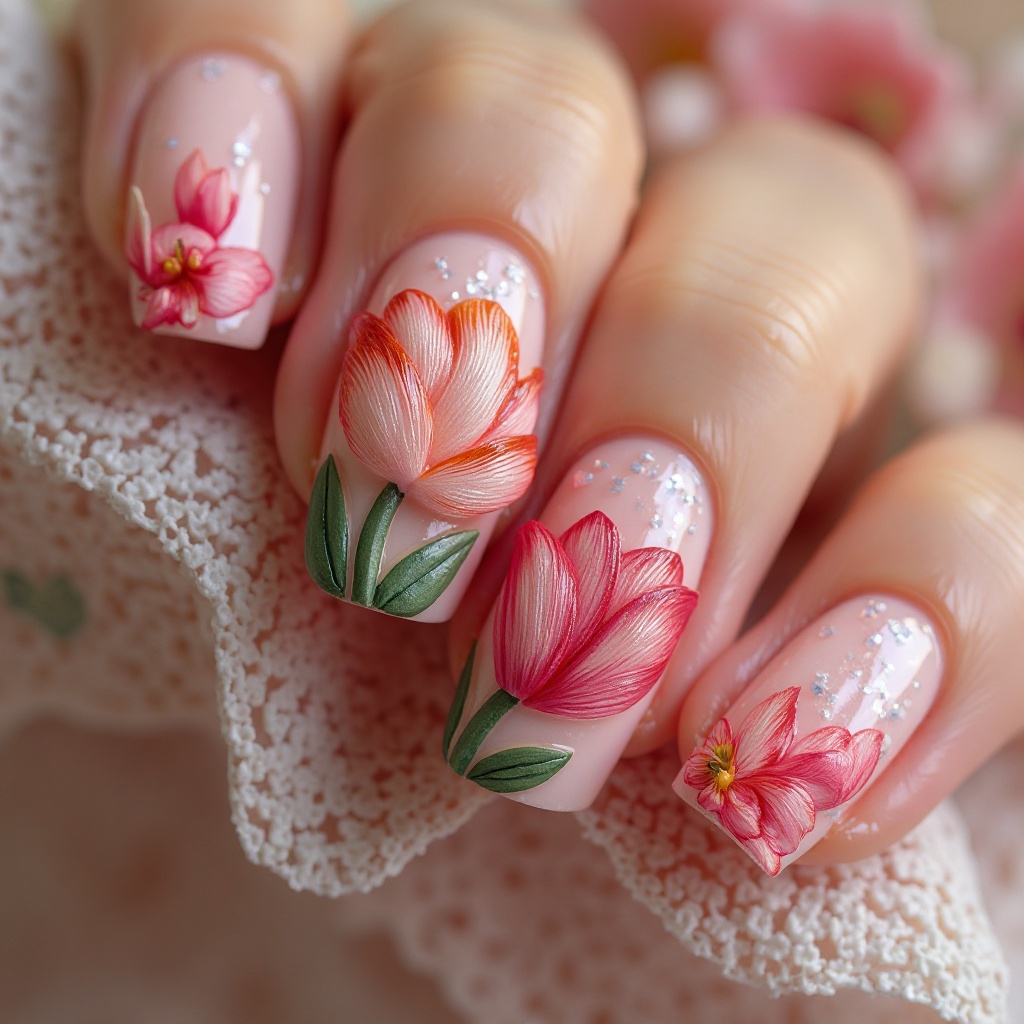
One or two accent nails feature actual three-dimensional tulips sculpted from acrylic or gel, while the remaining nails showcase a coordinating solid color or subtle tulip print. The 3D blooms are delicate and lightweight, crafted petal by petal with realistic curves and depth.
| Detail | Info |
| Difficulty | Advanced (simplified version: Intermediate) |
| Time to complete | 40–50 minutes (simplified version) |
| Best for | Special events — bridal showers, galas, photoshoots |
Why it works: Limiting 3D elements to one or two nails makes them feel intentional and luxurious rather than overwhelming. The sculptural element draws attention without making the nails impractical.
What makes it different: True 3D acrylic requires salon training. The simplified home version described below uses thick polish layering to create a raised effect that’s achievable without professional equipment.
Honest note: True salon-quality 3D nails require professional training and equipment. The home version above creates a raised effect that looks good in photos but won’t have the same sculptural quality.
Soft Neutral Options
12. Taupe Tulip Elegance
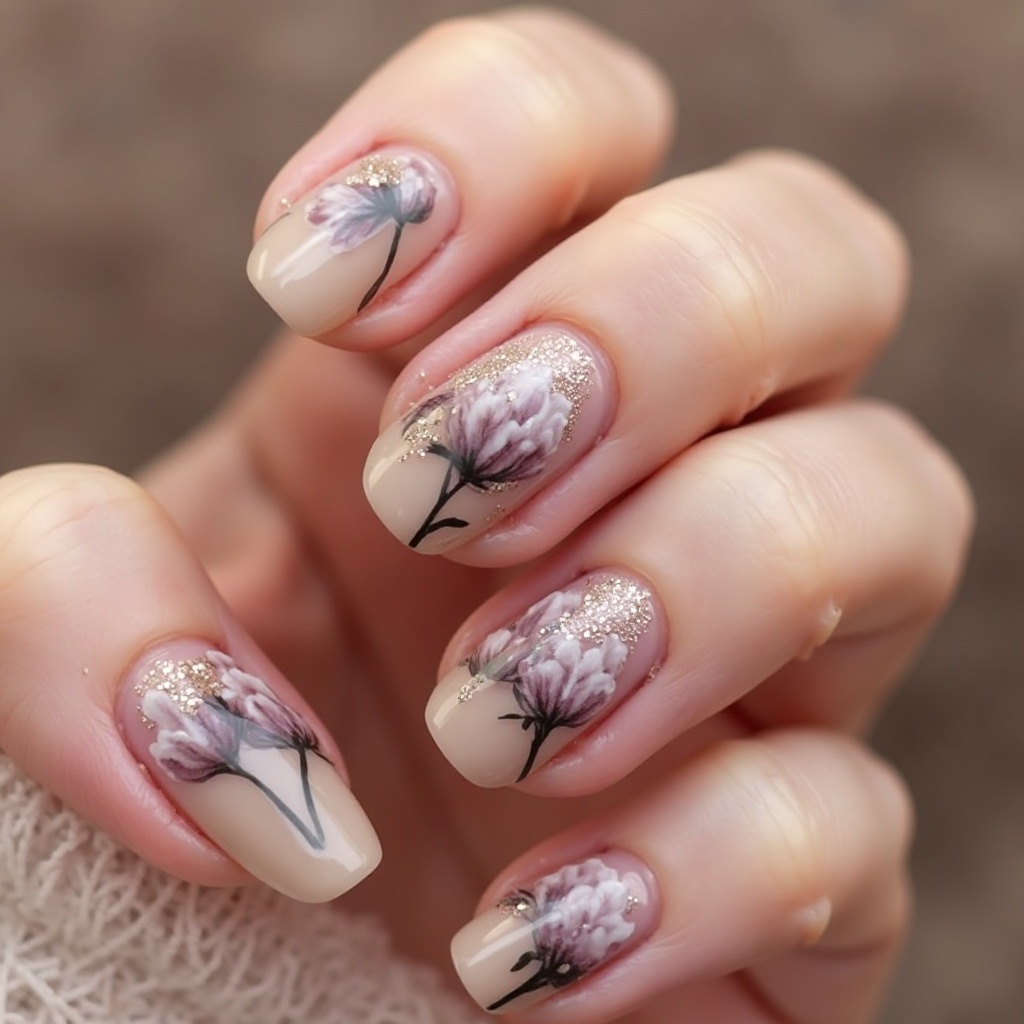
Warm taupe tulips with subtle mauve undertones bloom across a barely-there beige base. The neutral-on-neutral palette feels incredibly sophisticated, with just enough tonal variation to make the flowers visible. Tiny champagne shimmer accents on the petal edges catch light without screaming “glitter.”
| Detail | Info |
| Difficulty | Intermediate–Advanced |
| Time to complete | 40–45 minutes |
| Best for | Professional environments; neutral palette lovers; formal occasions |
Why it works: The monochromatic approach — all neutrals — creates sophistication through subtlety. This is nail art for people who appreciate it when you notice it up close, not from across the room.
What makes it different: Getting readable tulips from very similar neutral shades requires precision that most nail art doesn’t. The champagne shimmer on petal edges is the detail that makes it work — it creates definition that tonal contrast alone doesn’t.
Honest note: Work in strong lighting. The subtle color difference is nearly invisible in dim light, which makes it easy to miss placement errors until it’s too late to fix them.
13. Cream and Caramel Tulip Combo
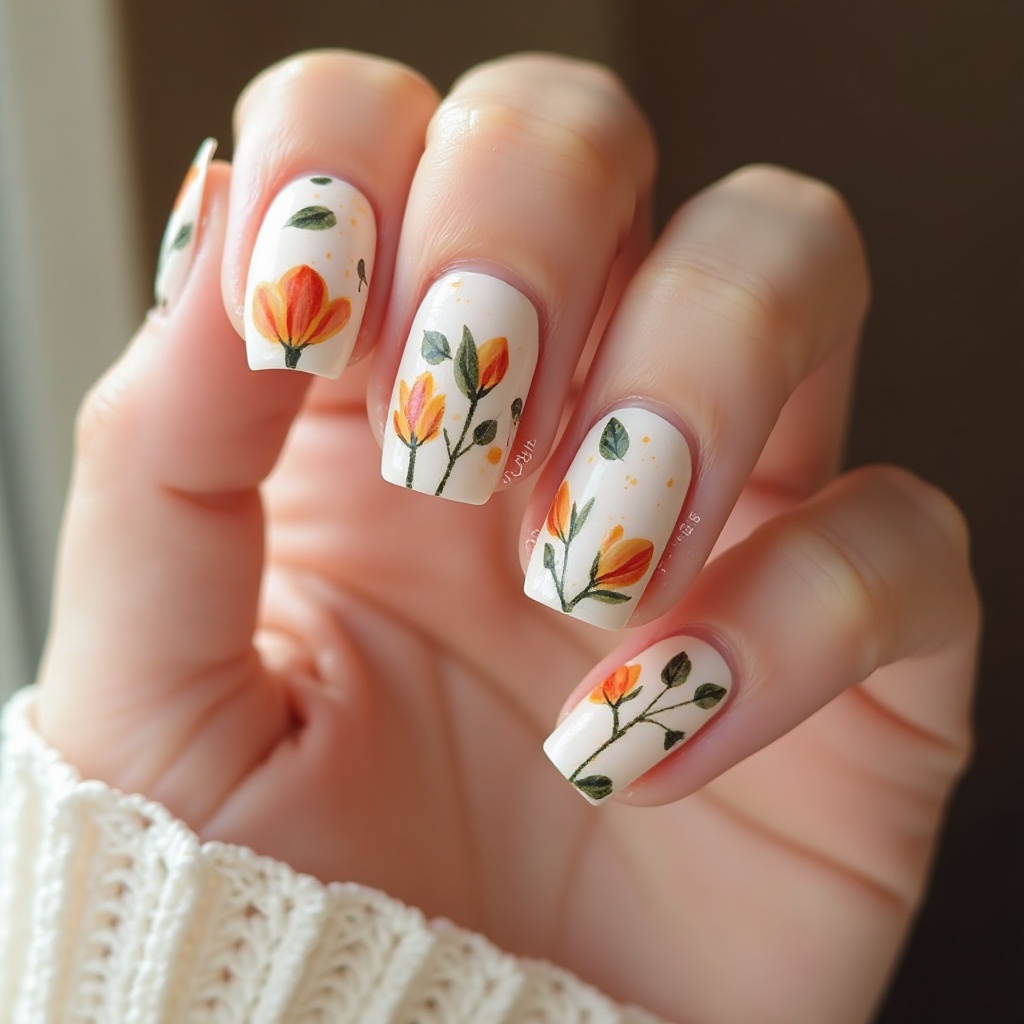
Creamy off-white tulips alternate with warm caramel-colored blooms on a soft ivory base. The monochromatic neutrals create a cozy, approachable vibe that feels like spring in a coffee shop. Matte finish enhances the sophisticated, understated aesthetic.
| Detail | Info |
| Difficulty | Beginner–Intermediate |
| Time to complete | 30–35 minutes |
| Best for | People who prefer a warm, neutral palette year-round |
Why it works: Alternating cream and caramel tulips across the nails creates rhythm — your eye moves from nail to nail naturally. The matte finish unifies the subtle color differences and gives it a premium feel.
What makes it different: The matte topcoat is non-negotiable here. The same design in glossy finish looks flat. The matte creates that editorial, editorial cafe aesthetic that makes the neutrals feel intentional rather than boring.
Bold Maximalist Looks
14. Full-Coverage Tulip Mural
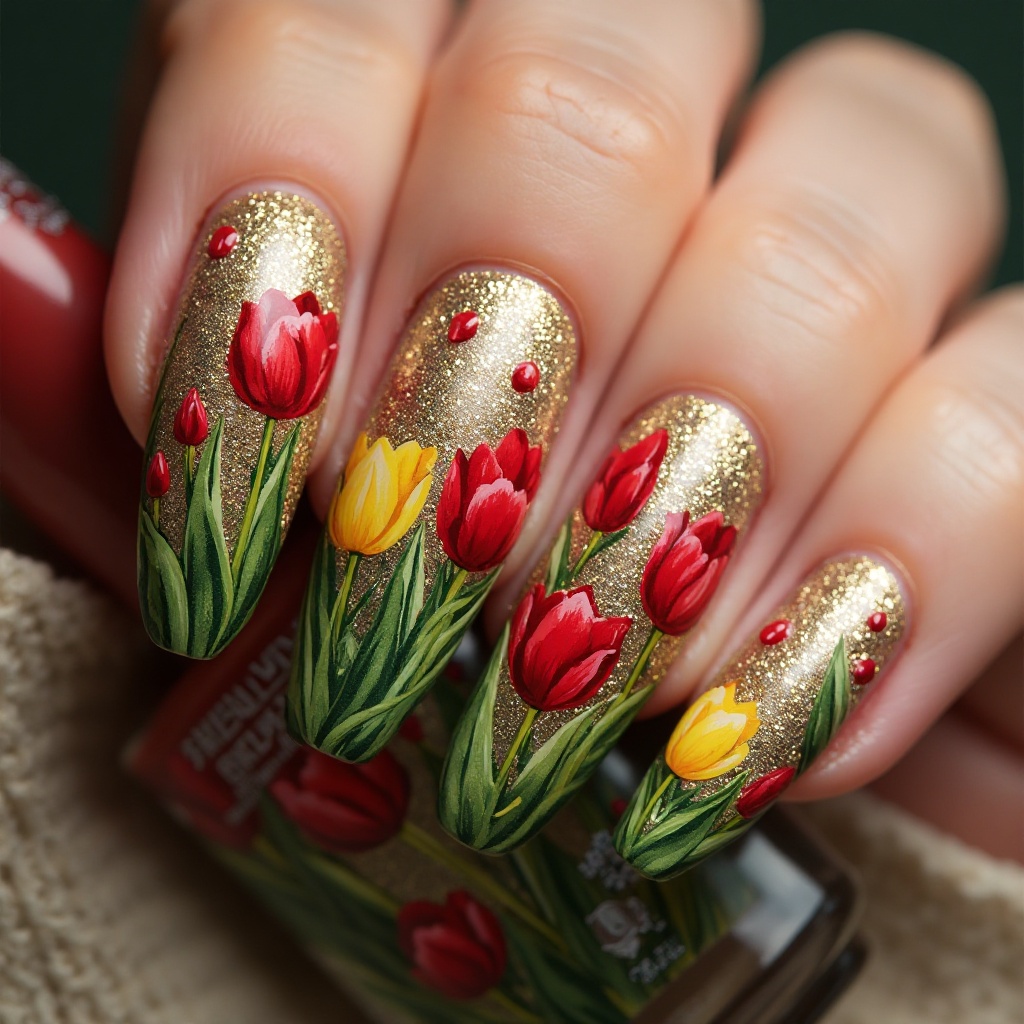
Every single nail becomes part of a connected tulip garden scene, with flowers, stems, and leaves flowing from nail to nail. When you place your fingers together, the design aligns to create one cohesive botanical illustration. Rich jewel tones of ruby red, emerald green, and golden yellow make it pop.
| Detail | Info |
| Difficulty | Advanced |
| Time to complete | 90–120 minutes |
| Best for | Artists and experienced nail art enthusiasts; special occasions; when you want to really commit |
Why it works: When fingers are placed together, the design creates one continuous scene across all ten nails. The visual payoff is significant — it genuinely looks like wearable illustration.
What makes it different: Most nail art is five separate designs. This is one design across ten nails. The planning process is completely different, and getting the alignment right requires working nail-by-nail in order.
Honest note: This one is genuinely hard to do well at home. Unless you have painting experience and a lot of patience, consider using this as a reference for a salon appointment instead.
15. Neon Tulip Pop Art
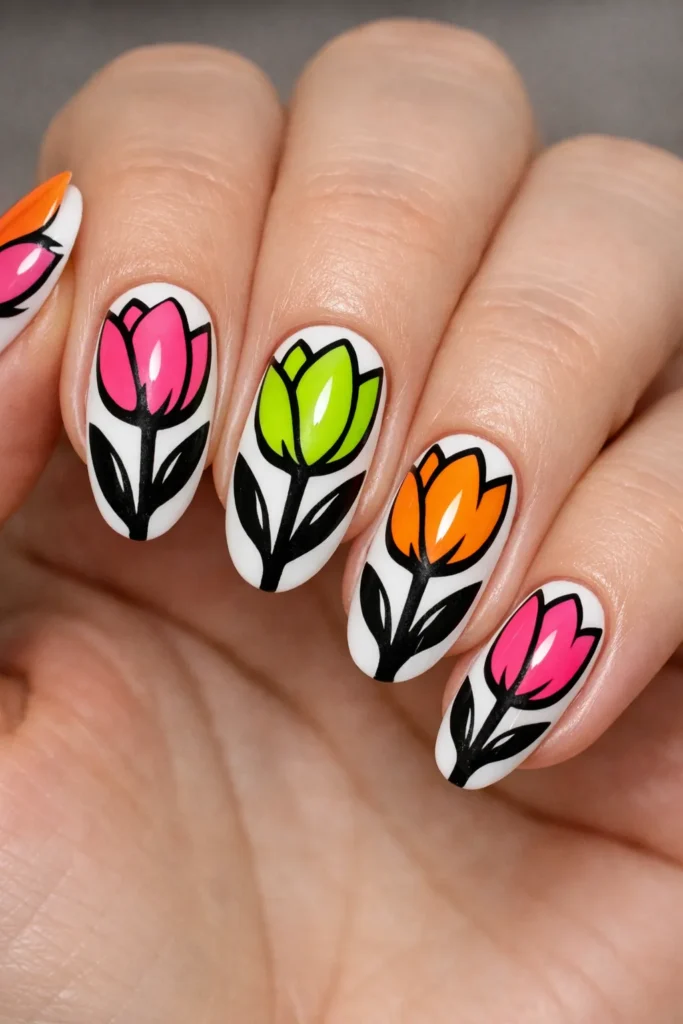
Electric neon tulips in hot pink, lime green, and electric orange explode across a stark white base in a pop art style. Bold black outlines give each flower a graphic quality, while the fluorescent colors feel energetic and modern. The result is spring on steroids.
| Detail | Info |
| Difficulty | Intermediate |
| Time to complete | 45–50 minutes |
| Best for | Bold personalities; festival season; summer transition |
Why it works: The bold black outlines give neon colors structure that they’d otherwise lack. Without the outlines, neon tulips on white look like blobs. The outlines are what create the pop art graphic quality.
What makes it different: Neon nail art is usually either entirely neon or uses neon as an accent. Here the graphic black outline treatment turns simple tulip shapes into something that references a specific art style (Roy Lichtenstein-esque), which gives it more conceptual depth.
Product tip: China Glaze Electric Nights collection or OPI Neons ($9-13 each) have the best pigmentation. Always apply a white base coat underneath — it makes a significant difference to how vivid the neons appear.
Nature-Inspired Unique Concepts
16. Dewdrop Tulip Morning
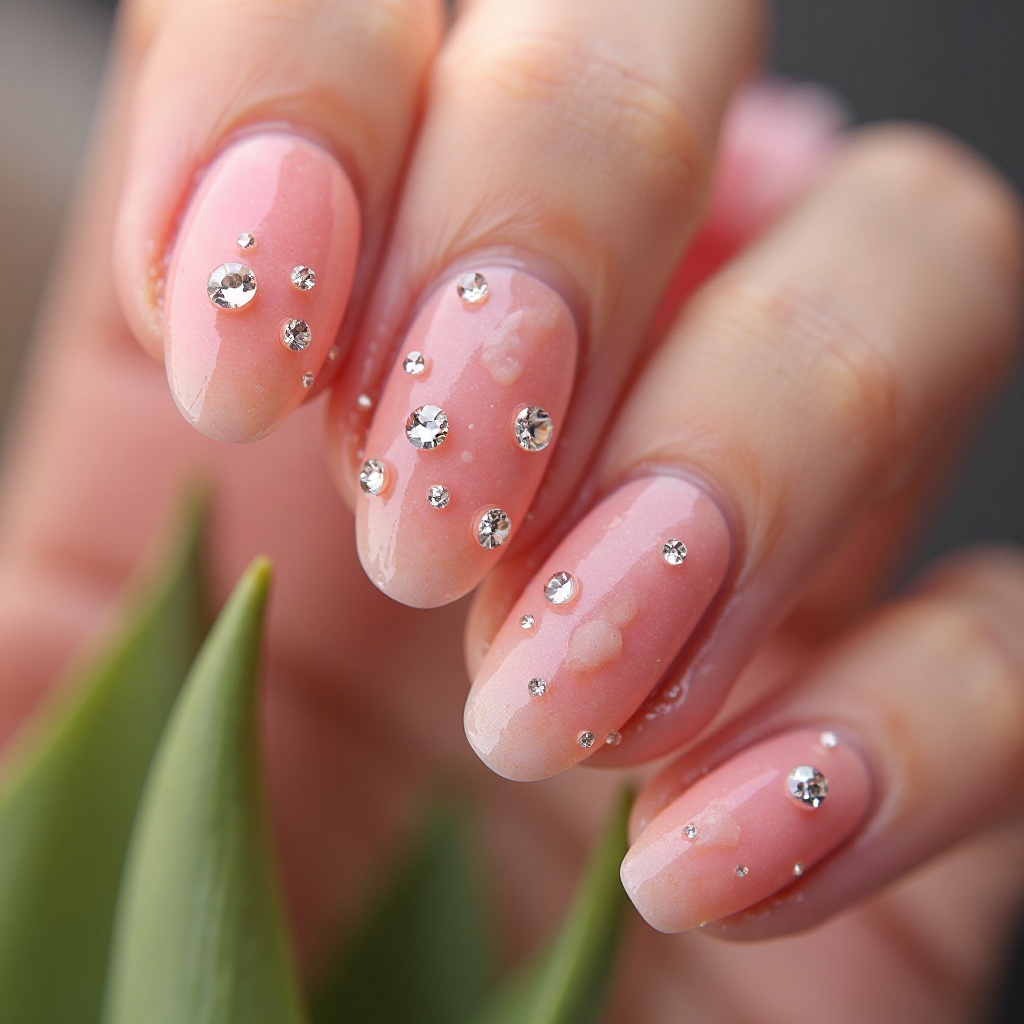
Pale pink tulips get adorned with tiny crystal rhinestones positioned as morning dewdrops on the petals. The base is a sheer peachy nude that mimics early morning light, and the strategically placed crystals catch light like actual water droplets. Glossy finish enhances the fresh, just-watered garden effect.
| Detail | Info |
| Difficulty | Beginner–Intermediate |
| Time to complete | 35–40 minutes |
| Best for | Weddings, garden parties, spring photoshoots |
Why it works: Rhinestones placed strategically (2–3 per tulip, on petal edges and centers) read as water droplets because of how they catch and scatter light. It’s a simple addition that makes the whole design feel elevated.
What makes it different: Many rhinestone nail designs use rhinestones as the focal point. Here they serve the story of the design — the dew on fresh spring flowers. That specificity is what keeps it from looking generic.
Product tip: Multi-size rhinestone packs on Amazon ($6–10) include enough stones for dozens of manicures and come with several sizes that work well for this technique.
17. Two-Tone Tulip Geometry
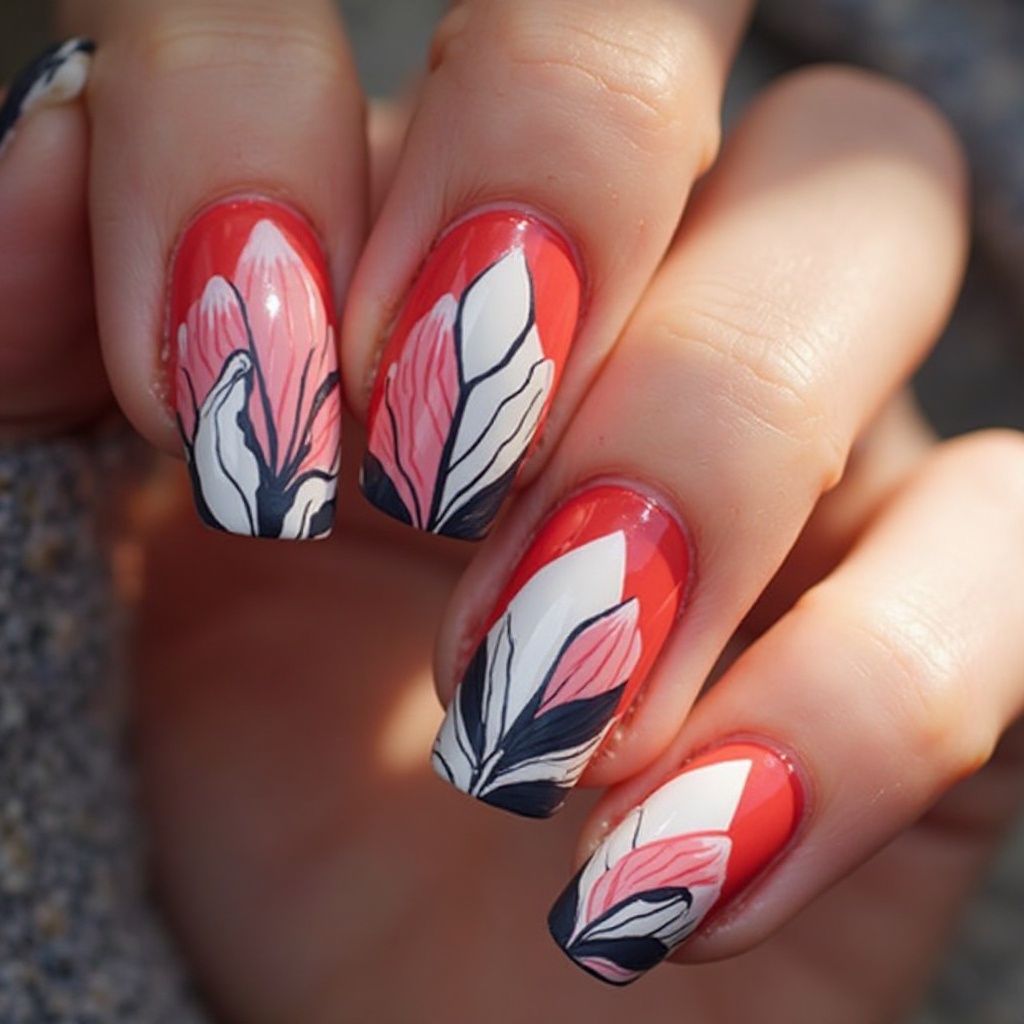
Tulips are painted in bold color-blocking style, with each petal split into two contrasting colors—like coral and white, or navy and pink. The geometric division of color creates a modern, abstract take on traditional floral nail art. Clean lines where colors meet are essential to the sharp, contemporary aesthetic.
| Detail | Info |
| Difficulty | Intermediate–Advanced |
| Time to complete | 50–60 minutes |
| Best for | People who want floral nails but with a modern, graphic edge |
Why it works: Color-blocking each petal into two contrasting halves creates a graphic quality that’s distinctly modern. The tulip shape grounds it in the spring theme while the geometric execution makes it feel contemporary.
What makes it different: This is the only design here that deliberately introduces geometric abstraction into a floral form. It bridges two different aesthetics rather than committing fully to either one.
Honest note: This takes a few practice runs to get the tape placement right. The first attempt is usually cleaner on the non-dominant hand.
Common Mistakes and How to Fix Them
Mistake 1: Tulip Designs That Are Too Large for Your Nail Size
What it looks like: The flowers look crowded and cartoonish, fine details are indistinct, and the overall effect is ‘busy’ rather than elegant.
Why it happens: People copy designs made for longer, wider nails without scaling them down — or they try to fit too many flowers onto one nail.
How to fix it:
- Scale down: one small tulip per nail, not three
- Switch to buds or partial petals — these imply the flower without showing the whole thing
- Try outline or silhouette versions, which read clearly even at small scale
- If at a salon, tell your nail tech to scale to your nail size, not the reference photo
Mistake 2: Skipping Base Coat
What it looks like: Your natural nails are stained yellow or orange from pigmented polishes (deep coral is the worst offender). The manicure also lifts from the nail faster.
Why it happens: Base coat feels like an unnecessary step when you’re already doing elaborate art, but it’s doing two jobs: protecting your nails from staining and creating adhesion for the polish layers above.
How to fix it:
- Always apply at least one thin coat of base, even under nail art
- For very staining colors, use two thin base coat layers
- If nails are already stained, buff gently and use a whitening treatment before your next manicure
Mistake 3: Neglecting Cuticle Prep
What it looks like: Ragged cuticles and uneven skin around the nail edge make even professional nail art look unkempt. Polish applied over dry, lifted cuticles also chips significantly faster.
Why it happens: Cuticle prep feels like extra work before the ‘real’ part of the manicure. But messy cuticles are visible in every photo and in person.
How to fix it:
- Soak fingers in warm water for 5 minutes before painting
- Push back cuticles with a wooden stick — never cut them, as this causes ragged regrowth
- Apply cuticle oil daily between manicures; dry cuticles are the root cause of most chipping at the edges
- Book your nail appointment at least 2 days after any cuticle trimming
Mistake 4: Using Too Many Colors in One Design
What it looks like: The nails look chaotic and undefined — different colors compete for attention and nothing reads clearly.
Why it happens: Spring nail inspiration is colorful, and it’s tempting to try to incorporate everything. But more colors almost never means better results.
How to fix it:
- Limit any single design to 2–3 main colors
- Choose from the same tonal family (all pastels, or all earthy tones — not both)
- Let one color be the focus; the others support it
- If you love many colors, rotate between manicures rather than fitting them all in at once
Mistake 5: Not Sealing the Free Edge
What it looks like: The polish starts chipping from the tips within 24–48 hours, even on a fresh manicure.
Why it happens: Most people apply top coat across the nail surface but don’t ‘cap’ the tip by swiping it across the free edge. This leaves the ends unprotected.
How to fix it:
- Swipe top coat over and slightly under the free edge, not just across the surface
- Reapply top coat every 3 days, always capping the edge again
- If you notice early lifting at tips, reseal immediately with a thin clear coat
Maintenance Tips by Week
Days 1–3: Setting the Foundation
- Avoid prolonged water exposure for the first 24 hours — dishwashing, long baths, and swimming all affect adhesion while polish is still fully curing.
- Apply cuticle oil every evening (Burt’s Bees Cuticle Cream, $7, or CND Solar Oil, $10–14) — this keeps the skin around your nails supple and reduces lifting at the edges.
- If you’re wearing regular polish, apply a thin refresh layer of top coat on day 3 to extend wear.
Days 4–7: First Week Check
- Check the tips for early chipping. If you catch it on day 4, a thin swipe of top coat will reseal it. If you wait until day 7 it’ll likely be peeling.
- If you have a matte finish design, reapply matte top coat now — matte finishes go shiny within 4–5 days of regular wear.
- Wear gloves for cleaning and dishwashing without exception. The chemicals in dish soap are harder on nail art than water alone.
Days 8–14: Second Week
- For gel designs, this is when you’ll start seeing some growth gap at the cuticle. This is normal and doesn’t require action unless it bothers you visually.
- Apply cuticle oil every 3 days minimum to prevent the skin around your nails from drying out — dry cuticles make the growth gap look more pronounced.
- For regular polish, you’re likely at the end of the realistic wear period. Consider a fresh manicure rather than patching.
Days 15–21: Weeks 3+
- Gel manicures can hold well through week 3 if you’ve been diligent with maintenance, but the growth gap is usually noticeable enough to bother most people.
- If you notice any lifting at the edges, avoid picking or peeling — this damages the natural nail underneath. Use acetone wraps to remove properly.
- Removal: wrap each nail in a cotton pad soaked in acetone, cover with foil, wait 15 minutes, then slide off gently. Don’t scrape.
What Do Tulip Nails Look Like After 3 Weeks? Real Wear Timeline
I’ve worn both gel and regular polish tulip designs through multiple wear tests. Here’s what actually happens:
Week 1 (Days 1–7):
Gel: Near-perfect condition through day 7. Maybe minor tip wear if you type a lot, but the art stays intact. The milky bases and pastel tulips look fresh.
Regular polish: Noticeably good through day 5 with diligent top coat refresh. By day 6–7, the dominant hand shows tip chipping and some smudging on designs with layered colors.
Week 2 (Days 8–14):
Gel: Still solid art-wise, though you’re starting to see the natural nail growth gap at the cuticle (2–3mm by day 14). The tulip designs themselves look fine.
Regular polish: Most people are ready for a change by now. Tip wear is significant and patches of the design may have chipped or faded.
Week 3 (Days 15–21):
Gel: The growth gap is now clearly visible (~4mm). The manicure still looks polished in photos if you angle your hands, but up close it’s clearly past its prime. Most people remove somewhere in this window.
Regular polish: If you’ve made it here, you’re doing better than average. There’s visible wear throughout, especially on designs with fine line work, which tends to fade faster than solid color areas.
Frequently Asked Questions
Do tulip nail designs work on very short nails?
Yes, but you need to scale down significantly. Single-petal designs, tulip buds, and line art all translate well to short nails. Full garden scenes or multi-flower designs per nail don’t — they look crowded and the details get lost. Designs #5 (Sage Green), #6 (Rainbow Pastel), and #8 (Black Line Art) all work especially well on shorter lengths.
How do I remove tulip nail art at home without damaging my nails?
For regular polish, use standard acetone remover — soak a cotton pad, hold it on the nail for 20–30 seconds before wiping. For gel, soak cotton pads in pure acetone, wrap each finger in foil, wait 15–20 minutes, then gently slide the softened gel off with a cuticle stick. The key is not scraping or peeling, which takes layers of natural nail with it.
Can I do tulip nail art without a thin brush?
For most designs, yes — a regular nail art detail brush from any drugstore ($3–5) will work. The exception is the line art designs (#8, #17) where a striping brush or nail art pen gives noticeably cleaner lines. If you’re doing any of the sponge-technique designs (#3, #7), the sponge is doing most of the work and brush precision matters less.
What’s the best way to make tulip nails last longer?
Three things make the biggest difference: applying top coat every 3 days (always capping the free edge), wearing gloves for cleaning and dishwashing, and applying cuticle oil daily. The cuticle oil is often overlooked, but dry skin around the nail edge is one of the main causes of early lifting at the edges.
Final Thoughts
Tulip nails are worth trying this spring — especially if you’ve been hesitant because you thought they required advanced skills. Most of the designs above, from the Soft Pink Tips to the Sage Green Medley, are genuinely manageable at home with a detail brush and a little patience.
A good place to start is Design #1 (Soft Pink Tulip Tips) if you want something foolproof, or Design #6 (Rainbow Pastel Mix) if you want something more visually interesting without much added difficulty. Both take under 40 minutes and don’t require any special equipment.
If you try one, the only thing worth knowing before you start is to give yourself more time than you think you’ll need — and to accept that the first attempt will teach you something the second attempt won’t.